
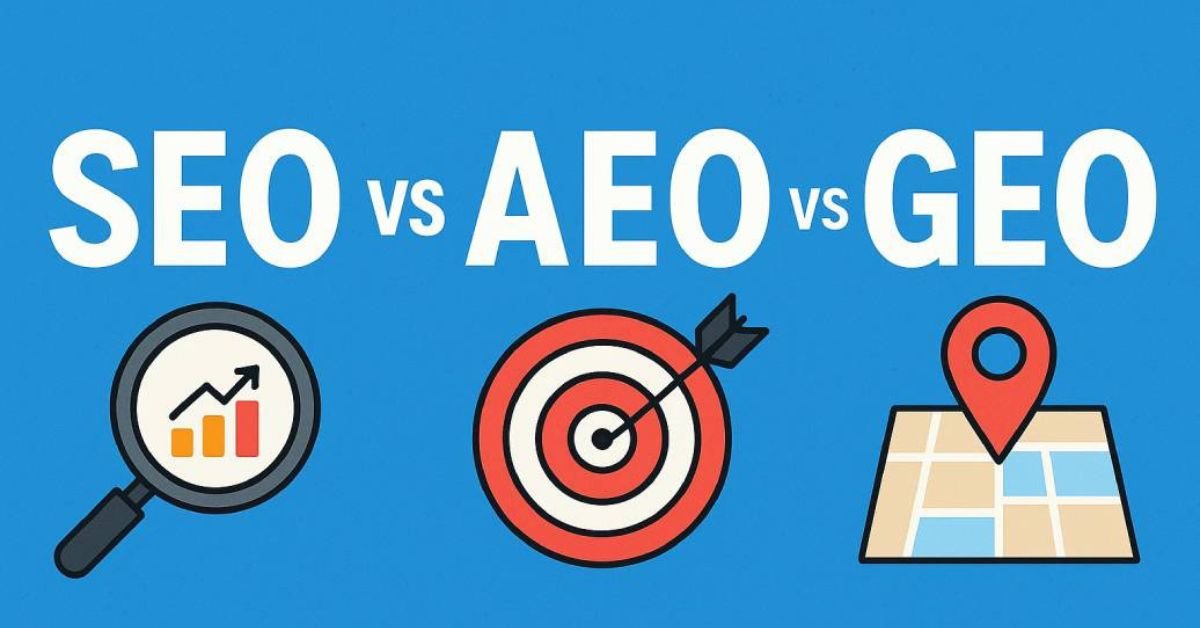
If you’ve been following digital marketing trends lately, you’ve likely encountered a barrage of new acronyms. SEO you know. But what about AEO? And now GEO? In 2026, understanding the difference between these three strategies — and knowing which one to prioritize — is the difference between growing your digital presence and watching it stagnate.
This guide breaks down all three clearly, so you can make smart, informed decisions for your business.
SEO: The Foundation You Cannot Skip
Search Engine Optimization (SEO) is the practice of improving your website’s visibility in traditional search results — primarily Google. The core levers are keywords, backlinks, technical performance, and content quality. SEO’s goal is to drive organic traffic to your website.
Despite the rise of AI-powered search, SEO remains essential in 2026. Google still processes over 8.5 billion searches per day. Strong SEO is also the foundation that makes GEO and AEO work — AI systems learn about your brand from the same sources that rank well in Google. You cannot skip SEO and go straight to AI optimization.
AEO: Optimizing for AI-Generated Answers
Answer Engine Optimization (AEO) focuses on getting your content cited by AI platforms like ChatGPT, Google’s AI Overviews, and Perplexity when users ask direct questions. Where SEO earns you a blue link, AEO earns you a citation inside the AI’s response.
AEO is critical when your audience is asking conversational, question-based queries. Think “What’s the best marketing agency for garment manufacturers?” rather than “marketing agency Toronto.” The AEO-optimized brand becomes the answer that the AI surfaces — often before any search result is shown.
GEO: Optimizing for Generative AI Experiences
Generative Engine Optimization (GEO) is a broader strategy that encompasses everything a business does to appear favourably across generative AI platforms — not just question-answer pairs, but across the full AI-assisted research journey.
GEO considers how your brand is represented across all the sources that AI systems pull from: your website, third-party publications, social platforms, review sites, forums, and more. If AEO is about the answer layer, GEO is about your brand’s entire digital footprint as seen through AI’s eyes.
Which One Should Your Business Prioritize?
The honest answer: all three, but in the right order. Here’s a practical framework based on where most businesses are today:
Stage 1 — Fix Your SEO Foundation
If your website is slow, poorly structured, or lacks authoritative content, start here. No AEO or GEO strategy will work on a shaky SEO base. A technical SEO audit, keyword strategy, and content improvements come first.
Stage 2 — Layer in AEO
Once your SEO fundamentals are solid, begin structuring content for AI answer engines. Add FAQ sections with schema markup, write direct Q&A formatted content, earn citations on authoritative third-party platforms, and ensure your brand is consistently represented across the web.
Stage 3 — Build Your GEO Presence
Expand beyond your website. Your brand should appear on LinkedIn, industry directories, news publications, and credible review platforms. GEO is an ongoing practice of managing your brand’s complete AI-visible presence.
The Businesses That Win Are Moving Now
In 2026, the majority of businesses are still focused exclusively on traditional SEO. That means the businesses that start building AEO and GEO strategies today are establishing authority in AI systems while the space is still uncrowded.
The window to gain first-mover advantage is real. Once your competitors establish citation dominance in AI answers, it becomes significantly harder to displace them.
Not sure which strategy your business needs first?
Our team at The 6th Avenue conducts comprehensive digital audits covering SEO, AEO, and GEO readiness — and we build a clear, prioritized roadmap for your specific goals.