
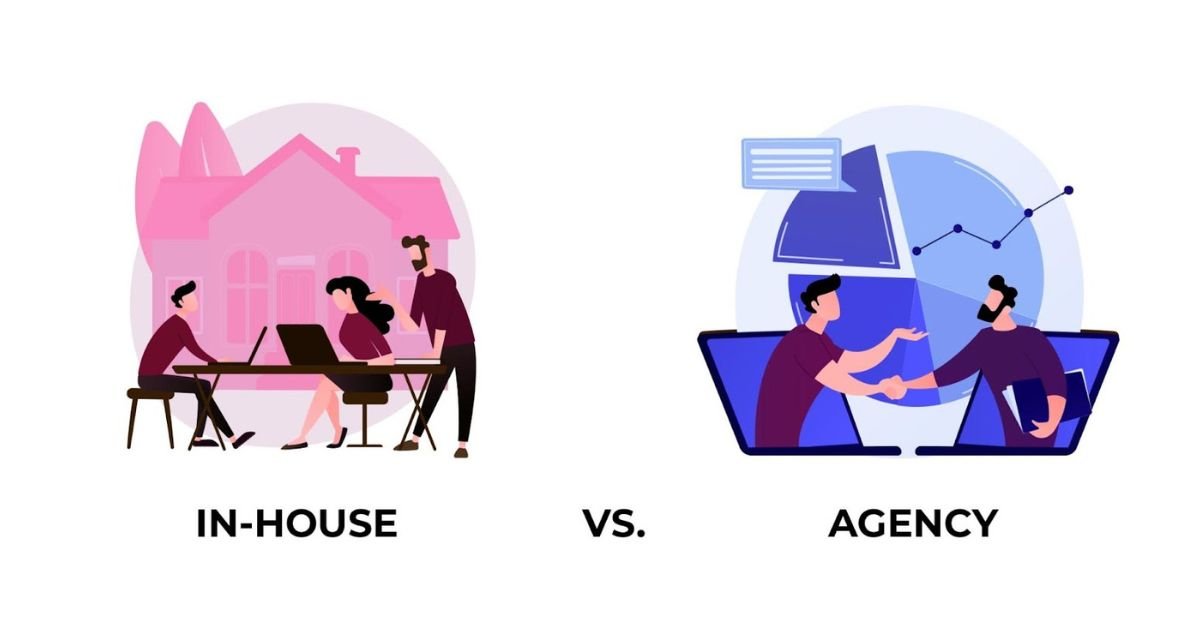
Choosing between an in-house marketing vs agency isn’t just a budget decision—it’s a growth strategy. In 2026, businesses have more options than ever, but also more complexity in deciding what actually delivers results.
An in-house team offers control, brand familiarity, and direct collaboration. On the other hand, agencies bring specialized expertise, proven systems, and the ability to scale quickly.
This Is One of the Most Important Decisions Your Business Will Make
Marketing is the engine of growth. And at some point, every business has to decide how to resource it. Do you build internally — hire a marketing manager, maybe a content person, eventually an ads specialist? Or do you partner with an external agency that brings the whole team ready to go?
Both approaches can work. But they work very differently, they cost differently, and they’re suited to different business situations. Here’s an honest, unvarnished breakdown of the real trade-offs in 2026.
The True Cost Comparison: What Most People Get Wrong
The most common mistake businesses make when comparing in-house versus agency is comparing the wrong numbers. They look at an agency retainer and compare it to one full-time salary. That’s not an apples-to-apples comparison.
A single in-house marketing hire — even a mid-level generalist — covers only a fraction of what a full-service agency delivers. Realistically, to replicate what a good agency provides (SEO, paid ads, content, analytics, strategy, reporting), you’d need at minimum three to five specialized in-house hires.
The true cost of in-house marketing:
- Mid-level marketing manager salary in Canada (2026): $65,000–$90,000/year
- Add benefits, CPP contributions, vacation pay, sick leave: typically 1.3–1.5x base salary
- A $75,000 hire becomes $97,500–$112,500 in total employer cost annually
- Plus: recruitment cost (typically $8,000–$20,000), onboarding time (2–4 months before full productivity), tools and software licences, training and professional development
- Multiply this across the 3–5 specialists you actually need — and you’re looking at $400,000–$700,000+ per year to replicate what a mid-tier agency delivers at $4,000–$12,000/month
An agency retainer, by comparison, is a consolidated cost that includes the team, the tools, the processes, and the accountability framework — all included.
Where In-House Teams Have the Genuine Advantage
This isn’t an argument that agencies always win. In-house teams have real, significant advantages in certain situations:
- Deep brand knowledge. An internal team member who has lived with your brand, product, and customers for two years has intuitive context that an agency team takes time to develop.
- Real-time responsiveness. Need something turned around in two hours? An in-house marketer can respond immediately without billable hours or scheduling friction.
- Cultural alignment. Internal marketers attend your all-hands meetings, absorb your company culture, and naturally stay aligned with strategic shifts.
- Long-term institution-building. If you are a large company with consistent, high-volume marketing needs and the resources to attract senior talent — an in-house team can become a genuine competitive asset.
In-house makes the most sense when your marketing needs are highly repetitive, brand-specific, and consistent enough to justify full-time salaries without the overhead of an agency relationship.
Where Agencies Consistently Outperform In-House
- Specialization breadth. Agencies pool specialists — SEO experts, paid media managers, content strategists, data analysts, developers — who would be prohibitively expensive to hire individually.
- Cross-industry exposure. Agencies work across multiple clients and industries simultaneously. This cross-pollination of ideas and tactics means they bring solutions they’ve already tested elsewhere.
- Scalability on demand. Need to double your ad spend for Q4 and pull back in Q1? An agency scales with you without the HR implications of hiring and laying off staff.
- Tools and technology access. Enterprise-level keyword research platforms, analytics dashboards, competitive intelligence tools, and ad management software are included in the agency relationship — not billed separately.
- Speed to deployment. Agencies have established processes. They can launch campaigns, configure tracking, and deploy content significantly faster than a new internal hire getting up to speed.
- Accountability structure. Agencies survive on results. Their retainers are renewed based on performance. This creates a different incentive structure than an internal employee whose position is rarely tied directly to measurable output.
The Hybrid Model: The Smart Move for Most Growing Businesses
The businesses getting the most from their marketing in 2026 are increasingly using a hybrid approach: a lean internal team for brand management, day-to-day communication, and strategic direction — partnered with an agency for specialist execution, campaign management, and scale.
For example: one internal marketing coordinator manages the relationship, approves content, and handles community responses — while the agency runs all paid advertising, SEO, analytics, and campaign strategy. This model captures the brand intimacy of in-house with the expertise and scale of an external team.
Which Approach Is Right for You?
If you’re a business with under $2 million in revenue and you need to grow customer acquisition — an agency is almost certainly more cost-effective than an in-house team at this stage. You’re a scaling business with $5M+ in revenue and consistent, high-volume marketing needs — a hybrid approach is worth evaluating. If you’re an enterprise with a complex brand and resources to attract senior talent — building internal capability alongside an agency partner is often the optimal model.
Not sure whether you need an agency or an in-house hire?
The 6th Avenue offers honest consultations to help growing businesses make the right resourcing decision — not just pitch you a retainer.